TADS Downloads
Download guide


Other TADS packages
Show full listIF Archive note: Many of the packages below are also available at the IF Archive, although the Archive's versions might not be as up to date as the ones here. We generally send updates to the Archive only at major releases.
How to choose an interpreter: If you're only looking to play games with TADS (not write them), choose a Player Kit or Interpreter package for your platform. In most cases you should choose a Multimedia interpreter, if available. (More on Multimedia vs Text interpreters)
Translations: For versions of the TADS 3 library in languages other than English, see translations.
Current release packages
The current TADS release is version 3.1.3.
Note that third-party packages sometimes need a little extra time to update to the latest code after a new TADS release. Information on which TADS VM or compiler version is in each package should be available on the package creator's Web site or in the package itself (release notes, About box, etc).
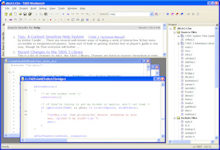
 Author's Kit for Windows with Full
Documentation. This has everything you need to write TADS 3 games
on Windows - the compiler, the Workbench development environment, the
libraries, and other tools. This Kit is packaged as an automatic
installer for easy setup: just download and run this file to install.
This package includes full documentation, including Getting Started
in TADS 3, Learning TADS 3, the TADS 3 Tour Guide,
the System Manual, the Technical Manual, and the
Library Reference Manual.
[Version 3.1.3; March 7, 2016; 18 MB download, 66 MB installed]
Author's Kit for Windows with Full
Documentation. This has everything you need to write TADS 3 games
on Windows - the compiler, the Workbench development environment, the
libraries, and other tools. This Kit is packaged as an automatic
installer for easy setup: just download and run this file to install.
This package includes full documentation, including Getting Started
in TADS 3, Learning TADS 3, the TADS 3 Tour Guide,
the System Manual, the Technical Manual, and the
Library Reference Manual.
[Version 3.1.3; March 7, 2016; 18 MB download, 66 MB installed]
Author's Kit for Windows - No
Documentation. This version of the Author's Kit includes all of
the same tools as the version above, but omits the
documentation. Instead, this package includes links to the
books on-line. If you have limited disk space,
you might prefer to download this smaller version.
[Version 3.1.3; March 7, 2016; 7.9 MB download, 22 MB installed]
Player Kit for Windows.
This is the full HTML TADS interpreter, which can play TADS 2 and TADS
3 games and features full multimedia support.
[Version 3.1.3/2.5.17; March 7, 2016; 2.0 MB download, 5.1 MB installed]
 FrobTADS provides a full, up-to-date
version of the TADS compiler and other developer tools for Mac OS
systems. The tools run as command-line programs, so this is best if
you're comfortable with the command shell.
FrobTADS provides a full, up-to-date
version of the TADS compiler and other developer tools for Mac OS
systems. The tools run as command-line programs, so this is best if
you're comfortable with the command shell.
QTads and
CocoaTADS (download) are
full Multimedia TADS Interpreters for Mac OS X.
Zoom is another
interpreter option for Mac OS users. Zoom is a multi-system
interpreter that plays games written for numerous other IF systems
besides TADS, so it saves you the trouble of installing multiple
interpreters. However, Zoom plays TADS games in text-only mode - it
doesn't provide Multimedia TADS features.
Spatterlight is another
multi-system interpreter for Mac OS, similar to Zoom. Spatterlight
runs TADS games in text-only mode.
FrobTADS is another interpreter option for
Mac OS users. FrobTADS plays games in text-only mode. Note that
installation is Unix-style (it's distributed as source code).
 QTads is Nikos Chantziaras's
full Multimedia TADS for Linux and other Unix platforms.
QTads is Nikos Chantziaras's
full Multimedia TADS for Linux and other Unix platforms.
FrobTADS is Nikos Chantziaras's version
of TADS for Linux and other Unix platforms. FrobTADS is distributed
as a highly portable Unix source package with easy-to-use autoconfig
installation. Please see the FrobTADS page
for full details.
 FrobTADS works not only on Linux, but
on almost all Unix and Unix-derived platforms as well.
FrobTADS works not only on Linux, but
on almost all Unix and Unix-derived platforms as well.
 A Kindle
version of FrobTADS is available for the Amazon Kindle Touch and Paperwhite
readers. Note that this version requires a jailbroken device.
A Kindle
version of FrobTADS is available for the Amazon Kindle Touch and Paperwhite
readers. Note that this version requires a jailbroken device.
A Kindle
version of Gargoyle is available for jailbroken Kindle devices (Touch,
Paperwhite, and Voyage). Gargoyle is a combined interpreter that can play
games in many systems, including TADS 2 and 3, Inform (Z-Machine), and
several others.
 FrobTADS
is also available for AmigaOS on PPC.
FrobTADS
is also available for AmigaOS on PPC.
 FrobTADS also runs on BeOS.
 Author's Kit for MS-DOS
(djgpp). This is a complete TADS 3 author/player kit for MS-DOS.
This version uses the "djgpp" 32-bit DOS extender (included in the
package), so a 386 or later processor (486, Pentium, etc) is required.
You don't need Windows to run this - just plain old MS-DOS.
[March 7, 2016; 3.7 MB download, 11 MB installed]
Author's Kit for MS-DOS
(djgpp). This is a complete TADS 3 author/player kit for MS-DOS.
This version uses the "djgpp" 32-bit DOS extender (included in the
package), so a 386 or later processor (486, Pentium, etc) is required.
You don't need Windows to run this - just plain old MS-DOS.
[March 7, 2016; 3.7 MB download, 11 MB installed]
À la carte components
These packages let you download individual components of the
system. Note that the release packages above usually include all of
the components you'll need, so you usually won't need to download the
items here separately if you've already downloaded the release package
for your system.
 t3launch.zip - php and MySQL scripts
for setting up your own TADS Web server, for client/server play across
the Internet. This is only needed if you want to set up your own
public server to contribute computing power to the TADS server
"cloud", or you want to run a private TADS server for your own game.
You don't need this to create a Web-playable TADS
game, since players can run your game on the public TADS cloud.
See the TADS 3 System Manual section on setting up a custom
TADS Web server.
[March 8, 2016; 20 KB download, 43 KB installed]
t3launch.zip - php and MySQL scripts
for setting up your own TADS Web server, for client/server play across
the Internet. This is only needed if you want to set up your own
public server to contribute computing power to the TADS server
"cloud", or you want to run a private TADS server for your own game.
You don't need this to create a Web-playable TADS
game, since players can run your game on the public TADS cloud.
See the TADS 3 System Manual section on setting up a custom
TADS Web server.
[March 8, 2016; 20 KB download, 43 KB installed]
TADS System Source Code (porting kit).
This is the generic C++ source code for the TADS 3
compiler, interpreter, and other tools, for porting the system to
other platforms. The package includes test scripts, system headers,
and documentation files. Important: You'll need the latest
version of TADS 2 for your platform in order to compile this - see the
TADS 2 Patch page for a download link.
[Version 3.1.3; March 8, 2016; 5.8 MB download, 24 MB installed]
Adv3 adventure game library.
The library is included in the Author's Kits, so you don't need to
download this separately unless it's dated more recently than the
latest Author's Kit (above). Note that you should always make sure
you have the latest Author's Kit if you download a new version of this
library.
[Version 3.1.3; March 7, 2016; 1.2 MB download, 4.6 MB installed]
System and run-time library
header files. This is a collection of header files defining
system interfaces. This is included in the Author's Kit and source
distributions.
[Version 3.1.3; September 25, 2013; 339 KB download, 1.0 MB installed]
Documentation. This is the full
documentation package, including Getting Started in TADS 3,
Learning TADS 3, the TADS 3 Tour Guide, the System
Manual, the Technical Manual, and the Library Reference
Manual.
[Version 3.1.3; March 7, 2016; 14 MB download, 46 MB installed]
Older packages (not currently maintained)
The following packages are out of date and are no longer being
maintained. These aren't recommended for current use; we mention
them primarily for historical reference, and also in case anyone is
interested in taking over any dead projects listed here.
TADS Workbench for Macintosh (download).
This is a full Aqua GUI wrapper for the development tools on Mac OS X,
created by M. Uli Kusterer. This is based on an older version of TADS
3, and hasn't been updated in several years. (This would be a nice
project to resurrect, since OS X is a popular platform for IF authors.
Contact Uli via his site if you're interested in adopting it.)
Author's Kit for Linux.
A pre-built Linux binary distribution of the the old Linux version of the
interpreter, compiler, and tools. Includes an automatic installer
script. This is the last build based on the old Unix porting layer,
which has been superseded by FrobTADS.
[December 16, 2011; 3.9 MB download, 12 MB installed;
based on the September 12, 2004 generic source distribution]
Author's Kit for Unix.
The old Unix version of the character-mode interpreter, and command-line
compiler and tools. This is a source-code distribution that works
on a wide range of hardware and Unix variants.
This is the last release based on the old Unix porting layer,
which has been superseded by FrobTADS.
[December 16, 2011; 3.9 MB download, 18 MB installed;
based on the September 2004 generic source distribution, plus Dan
Shiovitz's terminal I/O patch of 5/17/2005].